CLAY COUNTY – Despite the heavy cloud cover and ominous forecast, some river revelers already were drinking koozie-covered cold beers as they waded along a sandbar near the shoreline of the St. …
This item is available in full to subscribers.
To continue reading, you will need to either log in to your subscriber account, below, or purchase a new subscription.
Please log in to continueDon't have an ID?Print subscribersIf you're a print subscriber, but do not yet have an online account, click here to create one. Non-subscribersClick here to see your options for subscribing. Single day passYou also have the option of purchasing 24 hours of access, for $1.00. Click here to purchase a single day pass. |


CLAY COUNTY – Despite the heavy cloud cover and ominous forecast, some river revelers already were drinking koozie-covered cold beers as they waded along a sandbar near the shoreline of the St. Johns River or laid stretched across the bow of a boat waiting for the sun to finally break the dreary start to a Saturday morning.
And it was just 9:15 a.m.
With 39 miles of river and creek shorelines to patrol, Clay County Sheriff’s Office deputy Bill Maher knew it was going to be a busy day. Water is the lifeblood of the county’s recreation. For most, it’s the perfect place to fish, boat and make waves – literally. For a few, however, it’s a place where common sense can be easily misplaced. And as Maher has seen too many times, water can be unforgiving.
“Most people just want to have a good time,” he said. “When they do something wrong, we’re there. I’m not trying to ruin somebody’s day. I’m trying to keep them safe – and everyone around them safe.”
Which also includes manatees and alligators.
Maher said both animals currently are in their mating seasons. That’s why he pays particular attention to no-wake zones where manatees are known to spawn – especially around Doctors Lake. Protected zones are stretching through the shallows for 300 yards from the shoreline to the channel to keep the animals safe. Boaters who race through those zones will be pulled over – even on the water – by one of the county’s two marine unit boats.
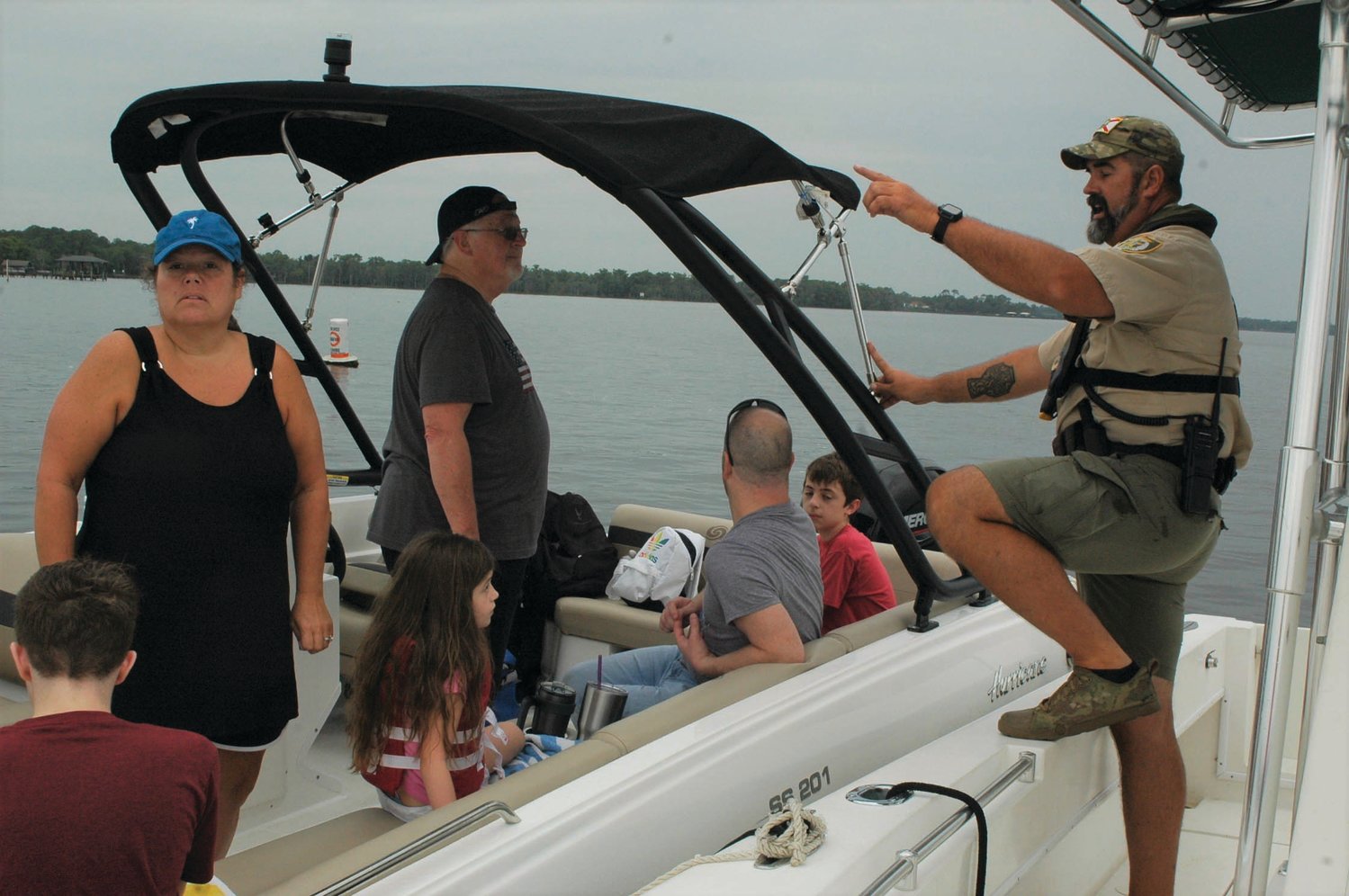
One family from Jacksonville rented a boat and was on Doctors Lake when Maher turned on his blue flashing lights. Although it’s marked by buoys, as novice boaters, they weren’t aware they were just caught in one of the county’s most important speed traps.
The family seemed genuinely surprised – and remorseful – so Maher gave them a warning. He also told them if they get caught again, they would get a ticket.
Ten minutes later, he made another stop for a boater going too fast in the low-wake zone. This time, the couple had just bought the boat and were making their third run. They too weren’t aware of the restrictions. When noticed the buoys and promised to be more aware, Maher wrote them a warning, too.
Maher has a different approach when he’s on the water. He said he believes educating boaters is every bit as important as enforcing county and state laws. It is a message that’s well-received along the St. Johns River, Black Creek, Swimming Pen Creek, Governors Creek and Doctors Lake. Residents often wave from the shore. Boaters generally wave as they pass. They know Maher could be holed up in a small cove on the creek waiting for a reckless driver, but they all know he’s simply trying to keep a semblance of order that benefits everyone.
And he’s always on the lookout for children not wearing a lifejacket as prescribed by law. And there no leeway for anyone driving recklessly or impaired, he said.
As the morning haze finally burned off, the waterways become more alive with activity. Children on top of large tubes and floats were being pulled by boats. Jet skiers and boaters congregated at an area known as “power line beach.” Partygoers were meeting at what’s become a popular hangout for hundreds of boaters off Moccasin Slough in the St. Johns. Locals call it Pineapple Point, and the party zone actually has its own Facebook page. During boater’s skip day last September, more than 1,000 people swarmed Pineapple Point.
“The water’s so shallow there I really can’t get my boat to them,” Maher said. “But I don’t get any trouble from them anyway. They come out and play in the water. Most of them bring their kids so they can get out and swim, too. This is why so many people love the water.”
Maher has a new 27-foot boat that was awarded to CCSO from a shared asset program grant through the Florida Sheriff's Association. He is the only deputy with a full-time assignment with the Marine Unit, but he works closely with similar units based in Jacksonville and St. Johns County.
“Our border goes to the middle of the river near the Shands [Bridge] and St. Johns’ border goes to the middle, too,” Maher said. “But if someone’s in trouble, we don’t argue about territory.”
Maher’s boat has been equipped with special sonar that helps him see the topography of the bottom of a river or creek. His boat has been instrumental in the recovery of victims since he’s able to identify their shapes without using divers.
“One of the strangest things I see on the bottom are shopping carts,” he said. “I haven’t figured that one out.”
As summer continues and the country awakens from its COVID-19 slumber, the waterways will become more active. Everyday Maher only issues several verbal and written warnings is a good day because it means everyone had a good time and came home safely.
Only to wake up the next morning and do it all over again.